|
Jackie
Chapman |
||
|
|
What should I expect from a McTimoney-Corley practitioner? Spinal
TherapyMcTimoney-Corley
Spinal Therapy is a method of restoring health by gentle, corrective
manipulation of the bones of the head, spinal column, pelvis and limbs,
therby ensuring the proper functioning of the nerves and endocrine
systems which control the natural self healing capability of the body. Therapists
are trained to assess bone misalignments by using their hands, and to
correct any of these subluxations with highly refined yet extremely
gentle manipulations. Remedial
exercises will be recommended and advice will always be given to help
avoid a recurrence of the problem. It
is important to realise that this therapy does not just relieve pain,
but it can, and often does, remove the cause of other dis-ease.
No cell or organ of the body can function properly without its
correct supply of nerve impulses. McTimoney-Corley
Spinal Therapy, when used regularly, can be used as a preventative
treatment, the frequency of which depends on the patient’s occupation
and life-style. Various
other manipulation techniques rely of fierce, or invasive, long-lever
adjustments to correct bone misalignments.
It is important to understand that this treatment does not do
this and cannot damage people or animals. McTimoney-Corley Spinal Therapy works with the body, not against it. Bones are not forced back into place, but are coaxed gently into positions be adjustments that encourage soft tissue release Treatable
Conditions The
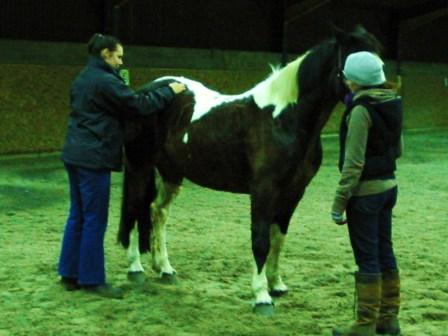
therapy has also been successfully adapted to treat most animals,
especially horses and dogs. After Your First Visit You will be asked to do very special exercises designed to help keep your body in its corrected situation. These exercises play a vital part in your recovery so it is important that you carry them out as prescribed. Problems
After Treatment It
all depends on how long you have had a problem and how your body has
adjusted itself in order to cope with that problem. Reactions
to the treatment are many and varied but it is normal to feel a little
achy all over for 2-3 days afterwards.
It is not usually necessary to have a follow-up treatment less
than 5 days after the initial one, as your body needs time to adjust. If
you are unhappy with any aspect of the treatment provided to yourself
(or your animal), it is vitally important to talk to your therapist as
soon as possible. There may
have been a misunderstanding which can be put right quite easily. Most
misunderstandings arise from a patient’s expectations of the
treatment. It is rare,
unfortunately, to emerge from the session with the problem completely
cured. Your body (or your
animal) needs time to adjust to the treatment. This can occasionally be instantaneous, but is usually a gradual process over the following 5 – 10 days. Often a follow-up treatment achieves even more so it is important to be guided by your practitioner Jackie
Chapman
|
|